I finished the yarn this morning, it’s still drying. I haven’t even measured it yet. But it looks really good:
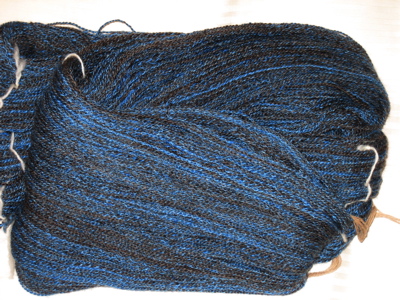
Now to get to work on the plain gray to go with it.
Feorlen's High Fiber Diet
I finished the yarn this morning, it’s still drying. I haven’t even measured it yet. But it looks really good:
Now to get to work on the plain gray to go with it.
This link arrived in my inbox the other day. I haven’t tried spinning old telephone parts yet, perhaps I should investigate further. I guess this would be the neighbor flock from the AT&T goatherd?
I didn’t do much spinning, but I did bring my wheel to Maker Faire. I ended up working the booth for one of The Boyfriend’s robot projects because they were short-handed. I got to see some people and play with robots a lot. I was Queen of the Flagging Tape and She Who Drives. When I did get a chance to spin, several people stopped by to chat and I taught a few folks how to use a spindle.
There were more fiber people with quite a lot of knitters showing up for a talk by Stephanie Pearl-McPhee, a knitting blogger. Like any good Maker, even one pressed into service at last minute, I was in the booth at the time. Such is life.
The Bizarre Bazaar was larger and had lots of interesting things and even some fiber here and there. I managed to lose my glasses in the craft hall and endured some minutes of panic until I discovered someone had turned them in to the volunteer table. I met dozens of people whose names I may remember if I can figure out where I put their business cards and/or flyers. As a non-tv person I had an interesting conversation with someone from CurrentTV (I work in the same building.)
I am still tired. And, of course, have zero pictures.
I tried out the new diz with the Merino I’ve been working on. I’m not used to a metal one so it took some adjustment. I have to be more careful to not pull too much fiber at once because it is not at all forgiving. Even with the plastic button I could kinda wiggle it through, and the milk bottle one would just get a larger hole (a different sort of problem.) I also have to remember not to let go of it. The button is small enough that I can leave it hanging there but this will pull the fiber apart.
There is one more bobbin and then I can start plying, I only started this project two years ago. Now that I have the new drum carder I may do more of this fleece flicked and carded, but for now I’ll continue with the combs. I’m not convinced there would be any observable difference, but I feel like I should be consistent and not change things in the middle.
I’ve been using a button as a diz, to pull fiber off the combs and into an even top for spinning. It works, but is a bother because the fiber tends to migrate around to the front side and tangle. And it is always getting lost. So this weekend I happened to be at a little get-together with The Boyfriend, where there just so happened to be your basic backyard machine shop. Because, you know, everybody’s got a machine shop out in the garage. Go burners!
Anyway, our host gave us a tour and some time later I was encouraged to go play in the shop. I used to do a bit of metalwork, long long ago, but it was entirely with hand tools. And blacksmithing, not cold metal. So while I’m generally familiar with the concept, I hadn’t used a drill press since middle school. My most recent experience was making hot metal flat and/or pointy with a homemade brake drum forge nearly ten years ago. And had no idea where anything was in somebody else’s shop.
So I rummaged around and found a suitable piece of flat steel. I bent it into a likely shape in the vise, we cut it to size, rounded the edges and then I polished it. Yes, it will rust, but I’ve got plenty of other steel equipment that I manage to keep in working order so I’m not worried about it.

What I am worried about is finding a new hobby. Or more correctly, picking up with an old one that I haven’t messed with in forever because I like living in cities. I’ve promised to bring the combs next time.

© 2004-2007 Andrea Longo
spinnyspinny at feorlen dot org